This post contains affiliate links. If you purchase through my links I may earn a small commission at no additional cost to you. I only recommend products we personally use and trust. Use code MADEWITHCLEAN to save $50 on your Tiny Health order. Thank you!
A gut test revealed what two years of pediatrician appointments never did. Our toddler had eczema from four months old, and not one doctor asked about her gut.
Small at first, behind her knees and on her wrists. Red, raised, and angry looking. I did what every new mom does and called the pediatrician. She took one look and said eczema. She handed us a prescription for a cream and sent us home.
That was the beginning of two years I would not wish on another mother.
Four pediatricians. One dermatologist. Every appointment followed the same script. Apply the cream when it flares. Avoid fragrance. Use a gentle detergent. Come back if it gets worse. Not one of them asked what she was eating. Not one of them mentioned her gut. Every conversation started and ended with her skin, as if her skin existed in isolation from everything else happening inside her body.
I started researching on my own. I am not a scientist and I am not a doctor. I am a mother with a laptop and a child who scratched until she bled, and I was not willing to accept that managing symptoms was the best we could do.
What I kept finding, across studies, practitioner interviews, and conversations in the functional medicine world, was a connection between gut health and skin inflammation in children. The gut microbiome plays a significant role in immune regulation. When it is out of balance, the immune system can overreact. In children, that overreaction often shows up on the skin.
We went back to our naturopath. The practice had a new doctor available immediately. We did not know yet that he had a deep background in nutrition. That turned out to be the thing that changed everything.

Claire’s First Tiny Health Gut Test Restults
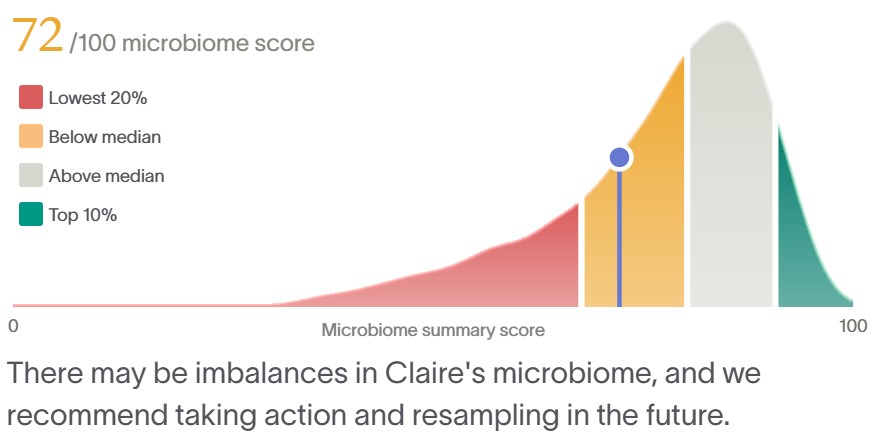
Claire’s first came back when she was 2.2 years old.
Her microbiome score was 72 out of 100, sitting in the below-median range. That number was not the most important finding. The three flagged areas outlined below were.
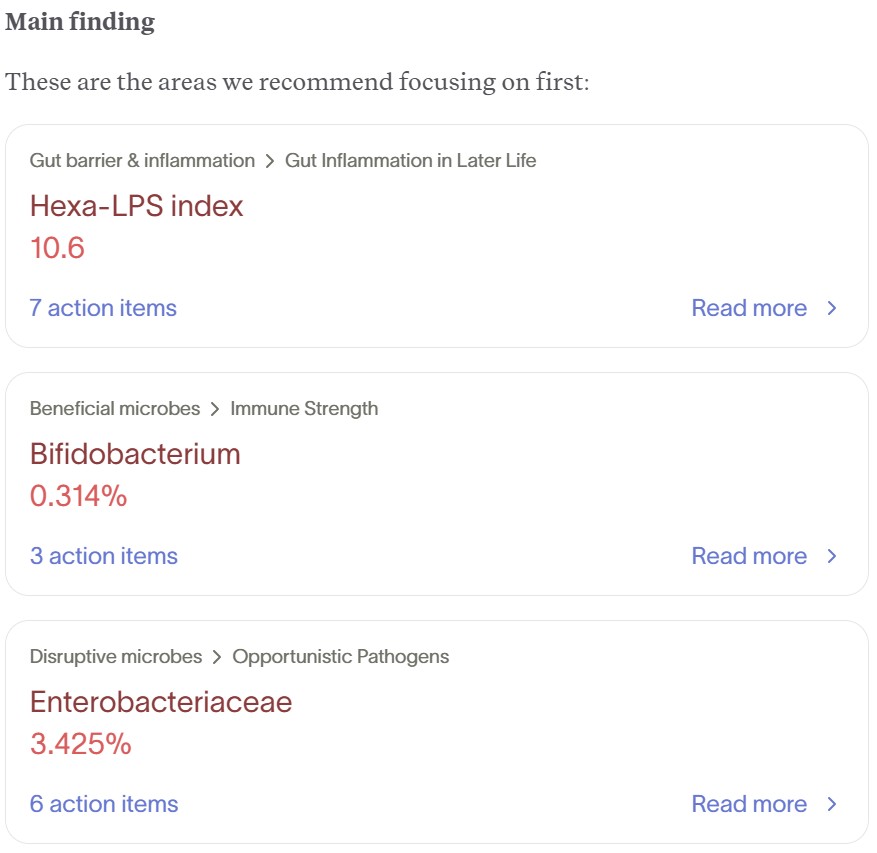
Her Hexa-LPS index came back at 10.6, an elevated marker tied to gut barrier function and downstream inflammation. Her Bifidobacterium, one of the most important beneficial bacteria in a toddler’s gut, was at 0.314%, well below where it should be at her age. Her Enterobacteriaceae, a family that includes opportunistic pathogens, came back at 3.425%, flagged as disruptive.
Claire had too little of the good bacteria, too much of the wrong kind filling the space instead.
If you want to understand exactly what the Tiny Health gut test measures and how it works, I covered that in detail here.
What the food sensitivity test showed
He also ordered a food sensitivity panel through US BioTek Laboratories, a CLIA-accredited lab, testing 96 foods for IgG immune reactivity. The results showed two categories of concern: foods with very high immune responses, including eggs and wheat, and a second tier of moderate reactions covering dairy, gluten, and several others. At that point we had no way to know which reactions were permanent and which might resolve as her gut healed.
When we retested, wheat had cleared entirely. Eggs came back as a Class IV reaction a second time. That consistency told us eggs were likely a true allergy, not just a sensitivity. We removed everything that showed a significant reaction and have been holding that elimination while her gut continues to heal. We are hoping that for most of the list, including eggs, the story is not over.
| Food | Reaction level |
|---|---|
| Chicken egg white, chicken egg yolk, duck egg whole, wheat | High to very high |
| Almond, avocado, casein, cheddar cheese, chickpea, cow’s milk, gluten, goat’s milk, spelt | Moderate |
| Gliadin, hazelnut, oat, rye, whey | Low |
IgG panel of 96 foods. Testing completed through US BioTek Laboratories, a CLIA-accredited lab, ordered through our naturopath.
Two tests. A clear picture. For the first time in two years, we had something specific to act on.
What we did
He recommended Biocidin, an herbal antimicrobial protocol designed to address the bacterial imbalance. He was direct with us: it often gets worse before it gets better. The die-off period is real, and Claire’s skin flared during it. We stayed the course.
We eliminated every flagged food and held that strictly for the full duration of the gut protocol.
The change did not happen overnight. Gut work does not. Over the following weeks the scratching decreased. The flares became less frequent and less severe. Her sleep, which had been disrupted for months from the discomfort, began to stabilize.
We were also making changes outside the gut at the same time. What we changed about Claire’s bath routine was part of reducing her total inflammatory load.
Where she is now
Claire’s skin is clear about 95% of the time. She still gets occasional flares. Egg exposure, illness, dry weather, or environmental shifts can all bring one on. They are minor. Nothing close to what we were living with before.
Our naturopath was straightforward with us from the beginning: atopic dermatitis has a chronic remitting course, and for children who are prone to it, the goal is not erasure. It is control. Research published in Sage Open Chronic Disease confirms that flares are an integral part of the condition, with some patients experiencing periods of remission interrupted by acute exacerbations. Knowing that changed how I measure success. A minor flare after egg exposure that clears in two days is not a failure. It is her immune system doing exactly what we now understand it to do.
The difference is that we understand the triggers now. We know her threshold. We know how to respond. That is the outcome two years of pediatrician appointments never gave us.
Two years of appointments that treated her skin as a surface problem. One gut test that finally looked underneath it.
If you are in the waiting-and-watching phase with your child’s eczema and no one has mentioned their gut yet, this is me mentioning it.
It is the same test we used for Claire. Use code MADEWITHCLEAN to save $50.
I am not a medical professional. Everything I share on Made With Clean is based on my personal experience, research, and conversations with our naturopath. Nothing on this site should be taken as medical advice. Always consult with your healthcare provider before making changes to your child’s diet, supplement routine, or health protocol.