This post contains affiliate links. If you purchase through my links I may earn a small commission at no additional cost to you. I only recommend products we personally use and trust. Use code MADEWITHCLEAN to save $20 on your Tiny Health order. Thank you!
If you are researching a Tiny Health gut test for your child, you have probably already been through the pediatrician visits, the creams, and the referrals that went nowhere.
The well-child visit has a job to do, and it does that job well. Height, weight, development, reflexes, a quick look in the ears. The pediatrician scans for what needs immediate attention and clears you to go home.
What it is not designed to do is investigate. It does not ask why a two-year-old with persistently inflamed, cracked skin keeps failing every cream her doctor recommends. It does not look at what is happening inside the gut. That system governs roughly 70 percent of the immune response, and it sits entirely outside the scope of a standard visit. No blame. It is simply not what the appointment was built for.
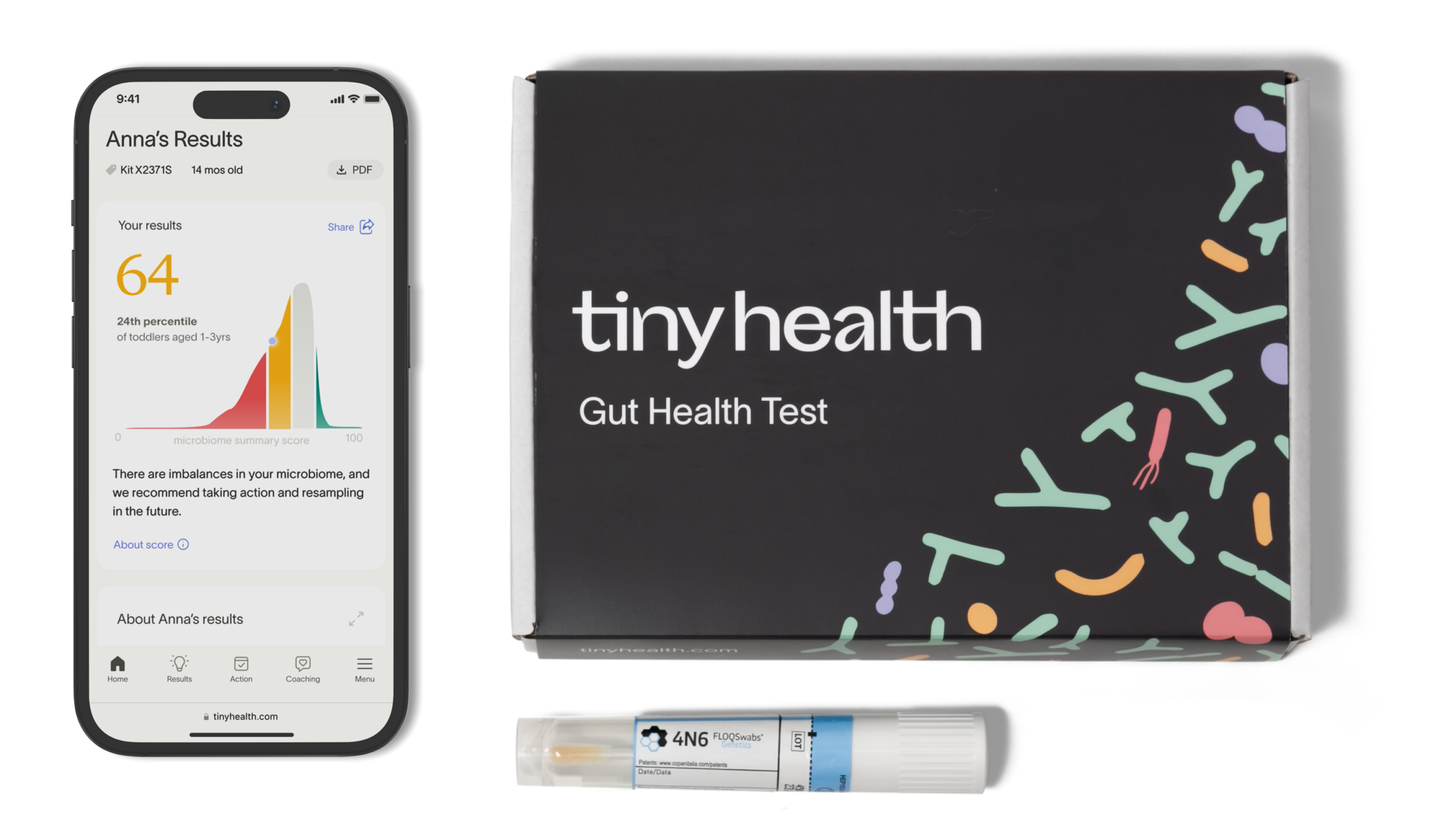
Claire’s skin started showing signs of eczema in her first months of life. By the time she was two, we had seen four pediatricians and a dermatologist. We had tried more creams than I can name. Some gave brief relief. None addressed the pattern. Every visit ended with the same clearance: nothing acutely wrong, here is the next thing to try.

Claire, before we had any answers. The eczema on the back of her knee was a fixture of daily life at this point.
I Was Doing Everything Right
That is the part I need to say clearly, because it is the part that made the two years so disorienting.
I exclusively nursed Claire until she was 16 months old. I home-cooked everything from scratch. No sugar before her first birthday, not a bite. After that, the occasional drizzle of raw honey or pure maple syrup, nothing more. We had already removed most processed food, most conventional cleaning products, and most of the obvious offenders from our home. This was not a late conversion for me. After Claire was born, I did a complete overhaul of how our family ate and lived, and I held that standard every single day.
By every measure I had been given, I was doing it right. Her gut was still a mess.
That is what the Tiny Health test eventually showed us. Not a failure of effort. A systemic problem that clean eating alone could not fix, because no one had ever identified what was actually wrong.
How a Gut Starts Behind
I have my own theory about why Claire’s gut was compromised from early on. I tested positive for Group B Streptococcus during my pregnancy. GBS is common, affecting roughly one in four pregnant women in the United States, and the standard protocol is IV antibiotics during labor. I received them. I have always wondered whether those antibiotics, which research shows do cross into the infant’s system, contributed to what we eventually found.
I want to be clear: our naturopath could not tell me definitively why her gut was in the state it was. This is my hunch as her mother, informed by research I went looking for after the fact.
What the research does show is that GBS intrapartum antibiotics measurably alter the infant gut even in vaginally delivered babies. A 2017 study published in Scientific Reports found that exposed infants showed significantly lower microbial diversity and a delayed colonization of Bifidobacterium in the first 12 weeks of life. Bifidobacterium is the dominant beneficial bacteria in the infant gut during the period when immune programming is most active. A 2025 study published in Frontiers in Immunology found that the reduction in Bifidobacterium longum specifically persisted not just through the newborn period but through one full year of age.
Claire was two when we finally tested her gut. Whatever partial recovery the research describes in the first year, it had not been enough. The eczema had not resolved. The food reactions had not resolved. Two years of clean eating had not moved the needle on something that started before she ever took her first bite of food.
My story is one version of this. There are many others.
Babies born by C-section miss the full microbial transfer that happens during vaginal delivery, a well-documented disruption to the gut’s founding population. Infants who received antibiotics in the first year of life for ear infections, respiratory illness, or other early childhood illnesses face their own version of this. High household chemical load, early introduction of processed foods, and environmental stressors are all factors the research associates with altered gut microbiome development. The through-line is the same: the gut can start behind, and without targeted support, it does not necessarily catch up on its own.
What the Pediatric Visit Cannot See
I am not suggesting that pediatricians are failing families. The standard of care is doing what it was designed to do. The gap is scope, not skill.
A well-child visit measures what is observable and acute. Gut microbiome composition is neither. It requires sequencing, comparison to age-matched data, and the kind of analysis that did not exist in a clinically accessible form until recently. The Tiny Health gut test uses shotgun metagenomic sequencing to produce a detailed picture of what is actually living in your child’s gut. It maps beneficial bacteria, opportunistic pathogens, diversity scores, and specific markers the research associates with immune and digestive function. It compares those results against a database of age-matched samples and generates recommendations specific to what it finds.
What our naturopath could do with that report was categorically different from anything four pediatricians had been able to offer. Not because he was more skilled. Because he had actual data to work from.
Why the Research on Early Gut Disruption Matters for Every Family
Eczema affects up to one in five infants and is the first step in what researchers call the atopic march, the documented progression from eczema to food allergies to hay fever to asthma. The gut disruption patterns associated with that march show up across a wide range of birth and early life circumstances.
The 2024 CHILD Cohort Study, published in the Journal of Allergy and Clinical Immunology and tracking 1,115 children from birth to age five, found that antibiotic exposure in the first year of life more than doubled the odds of developing at least one major allergic condition by age five. The researchers identified a specific gut bacterial signature present in children who went on to develop eczema, asthma, and food allergy. It is characterized by the same dysbiosis pattern these early disruptions produce.
For the family already in it, the mother who has tried the creams and the referrals and the elimination diets and is still watching her child suffer, the question worth asking is whether the gut has ever actually been looked at. Not assumed. Looked at.
For the mother whose child is not yet symptomatic, the research makes a specific case for acting before the symptoms arrive. Tiny Health’s own randomized controlled trial, published in Pediatric Allergy and Immunology in 2025, found that infants who received personalized gut health support had 83 percent lower odds of developing eczema compared to those who did not. The study followed 54 full-term C-section infants. Just 6 percent of babies in the intervention group developed eczema, compared to 29 percent in the control group.1
That is not a supplement claim. It is a peer-reviewed finding.
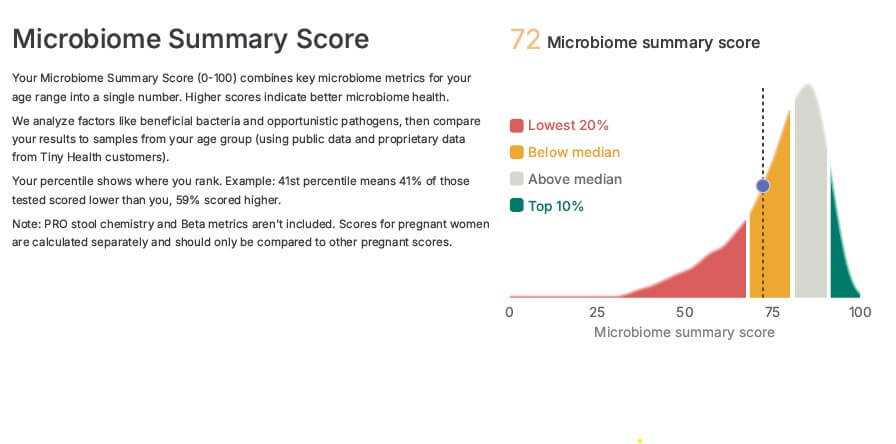
Claire’s first Tiny Health microbiome summary score, May 2025. A score of 72 placed her below the median for her age group.
What the Test Actually Shows
The Tiny Health report reads differently from anything a standard lab panel produces. It does not flag a single abnormal value and send you home. It maps the entire microbial ecosystem: what is present, what is missing, what is elevated, and what the research associates with each finding.
When Claire’s Tiny Health gut test results came back, we had a picture for the first time. Not a diagnosis. A map. One that showed us what had been depleted, what had overgrown in its absence, and what specific interventions the research supported. Our naturopath built a protocol from that map. Claire’s Tiny Health gut test scores improved measurably on retesting. Her skin followed.
The full protocol, what we did, in what order, and what changed at each stage, belongs in a dedicated resource rather than buried inside a blog post. What I can say here is that nothing we did in the two years prior had produced that kind of directional change, because nothing we did in the two years prior had started from actual data.
The Question Worth Asking Now
If your child has chronic eczema, recurring digestive symptoms, food sensitivities, or any of the early life factors that research associates with gut disruption, a C-section birth, intrapartum antibiotics, early antibiotic use, or simply a start that did not go as planned, the gut is worth looking at. Not as a last resort. As a starting point.
If you are looking for where to begin externally while you investigate the gut, our non-toxic bath routine is the first place we made changes.
The test is not a replacement for your pediatrician. It is the investigation the standard visit was never designed to run.
Sources
- Nieto PA, Nakama C, Trachsel J, et al. Improving immune-related health outcomes post-cesarean birth with a gut microbiome-based program: A randomized controlled trial. Pediatric Allergy and Immunology. 2025; 36:e70182. doi:10.1111/pai.70182
- Stearns JC, et al. Intrapartum antibiotics for GBS prophylaxis alter colonization patterns in the early infant gut microbiome of low risk infants. Scientific Reports. 2017; 7:16527.
- Lahtinen P, et al. Persistent reduction of Bifidobacterium longum in the infant gut microbiome in the first year of age following intrapartum penicillin prophylaxis for maternal GBS colonization. Frontiers in Immunology. 2025.
- Hoskin-Parr L, et al. Antibiotics taken within the first year of life are linked to infant gut microbiome disruption and elevated atopic dermatitis risk. Journal of Allergy and Clinical Immunology. CHILD Cohort Study. 2024.
I am not a medical professional. Everything I share on Made With Clean is based on my personal experience, research, and conversations with our naturopath. Nothing on this site should be taken as medical advice. Always consult with your healthcare provider before making changes to your child’s diet, supplement routine, or health protocol.